
From Google to GPT. Is Your Website Ready for AI Discovery?
Website discovery is evolving fast, and AI is reshaping how people find information.
For years, the game was simple. Rank on Google. Win the click. Convert the lead.
We optimized for keywords, structured headings, backlinks, metadata, and page speed. We obsessed over search intent and domain authority. And it worked.
But something is shifting.
These days, people are no longer just typing queries into Google. They’re asking full questions inside platforms like ChatGPT, Grok, and Perplexity AI. Instead of clicking through the top ten blue links, they want answers that are summarized, contextualized, and conversational.
That is a game changer. Now, your website doesn’t just need to rank. It needs to be understood.
The Shift: From Search Engine to Answer Engine
Traditional search engines like Google and Bing index pages and return results. The user chooses which site to click. Traffic flows through rankings.
Large Language Models (LLMs) do something different. They ingest information across the web and generate direct answers. In many cases, the user never clicks through to the source.
That means visibility is no longer just about being on page one. It’s about being referenced, summarized, or structurally legible to AI systems.

The question is no longer, “Does Google understand this page?”
It’s now, “Can an AI model extract meaning from it?”
What This Means for Your Website
If your website is vague, overly aesthetic, light on structured content, or built entirely around brand mood without clarity, AI has nothing solid to work with.
If your services are implied instead of clearly stated, AI won’t guess.
If your expertise lives only in visuals instead of language, it becomes invisible in an AI-driven ecosystem.
“Does my website need to be revamped?”
It depends.
A website built with strong SEO foundations will continue to thrive. Clear structure. Direct language. Defined services. Context. Internal linking. Authority signals.
The difference now is that the intent shifts from “ranking” to “retrievability.”
You’re no longer optimizing just for search queries. You’re optimizing to be cited.
Side-by-Side: Google vs AI Discovery
Here’s a simple breakdown of where things stand now and where they’re likely heading:
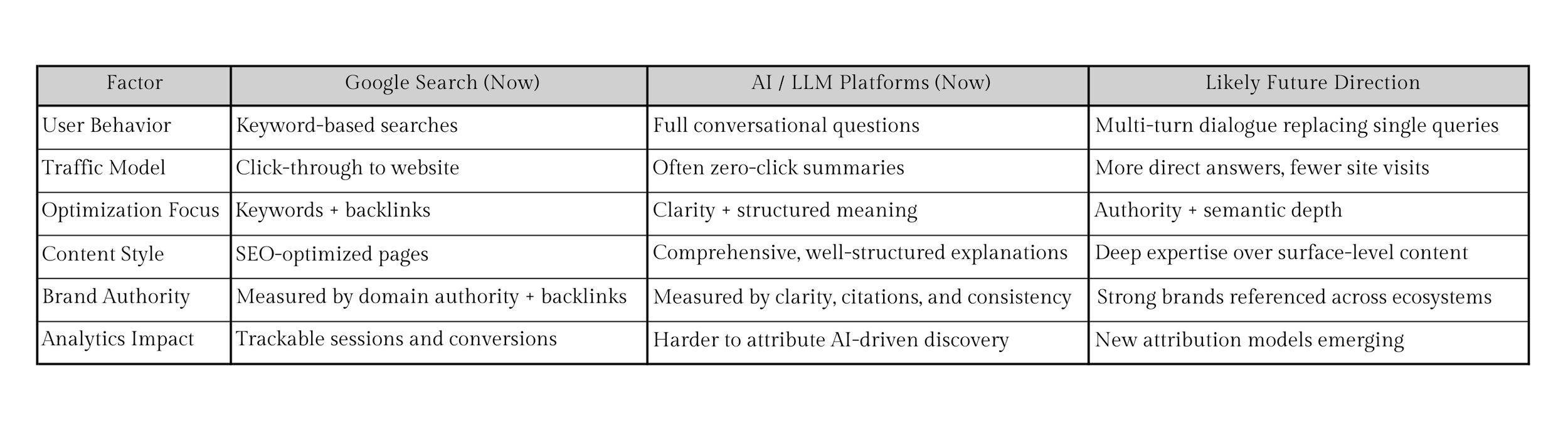
Google versus AI Discovery
Google isn’t disappearing. It’s evolving. And AI platforms are accelerating the shift toward intent-driven, conversational discovery.
How Do We “Keep Up with the LLM-nases”?
We stop thinking in silos.
This is not SEO versus AI. It’s structured clarity versus obscurity.
If your site clearly explains what you do, who you serve, where you operate, and why it matters, you’re already positioning yourself for both search engines and language models.
We write like humans but structure like systems.
Paragraphs should flow naturally, but headings should signal hierarchy. Definitions should be explicit. Services should be clearly labeled. Case studies should describe outcomes in plain language. If a model scans your site, it should immediately understand your expertise.
We build topical authority, not just pages.
AI systems promote expertise when they see depth and consistency. One thin blog post won’t do it. A body of work that explores a subject from multiple angles will.
We accept that traffic may look different.
The win may not always be a click. It may be brand familiarity because your company was cited in an answer. It may be inbound leads from people who say, “I kept seeing your name come up.”
What the Future Holds
The businesses that thrive won’t be the ones gaming algorithms. They’ll be the ones communicating clearly enough to be understood by both humans and machines.
Clarity scales where ambiguity does not.
Websites are no longer digital brochures. They are structured knowledge hubs. And the brands that understand this shift early won’t just rank well. They’ll become reference points.
That’s the difference.
And that’s how we keep up.